
Research prototype — disabled on mainnet and unsuitable for live funds.
Passing tests, benchmarks, and Lean 4 model proofs do not establish end-to-end cryptographic security. Both value conservation and spend authorization share one unreviewed single-oracle quantum random-oracle (QROM) extraction argument (Theorem 2A) and its circuit wiring, multi-transaction confidentiality relies on unreviewed privacy assumptions (and degrades if users reuse static receive addresses), and the Lean 4 models check algebraic and reduction plumbing from explicit hypotheses rather than linking mechanically to the compiled Rust or Go binaries. Independent external review may still require protocol changes.
Post Fiat L1 already signs public transactions and validator consensus votes with post-quantum ML-DSA-65 (FIPS 204). Its existing shielded pool, however, runs Zcash’s elliptic-curve Orchard protocol: encrypted notes archived on-chain today could be decrypted retroactively by a future fault-tolerant quantum computer, and elliptic-curve proofs could be forged to mint unbacked funds once such a machine exists.
Peel-Binius-Shielded (wire format PFSH03) is our experimental replacement built without elliptic curves. We chose a binary-field Binius proof system over prime-field STARKs or lattice SNARKs because SHAKE256’s bitwise Keccak gates express natively over \(\mathbb{F}_2\) without prime-field bit decomposition, letting every building block come from NIST standards (SHAKE256, SHA-512/SHA-384, AES-256-GCM, ML-KEM-1024, and ML-DSA-65). Standardized primitives do not make a novel proof system or its composition secure.
Model-level security target (conditional, unreviewed): Conditional on our unreviewed single-oracle QROM extraction proof (Theorem 2A / App. A.1–A.3), FIPS-204 ML-DSA-65, and 384-bit SHAKE256/SHA-384 collision resistance, the PFSH03 soundness upper bound reaches trivial probability 1 at \(Q = 2^{126.75}\) quantum oracle queries (~126-bit QROM model target, governed by 384-bit proof-tree collisions, with bound \(< 2^{-137.55}\) at \(Q = 2^{80}\) and \(< 2^{-92.25}\) at \(Q = 2^{96}\)). This figure marks where the conditional proof bound becomes vacuous—not an audited security guarantee or demonstrated attack cost. The sole sub-126-bit exception is an unpinned brand-new public L1 deposit account (~80-bit quantum address preimage until its first key-pinning transaction; strict pre-debit enforcement is available via prepare_pq_account_debit_pinned).
Current Project Status
- Established on this host (internal, single-team): End-to-end Rust/Go/L1 PFSH03 settlement (
751/751postfiat-nodetests, six-validator M8 rehearsal,7/7verify.shwith expanded Z3 + Rust/Go differentialpk_hash0/1audit), two-tier exit-safe pause + auto-expiring emergency exit-freeze, pruned-nodepq_bodies_v1storage (~95%disk savings), fail-fast verifier ordering + 4-thread sibling cancellation, low-RSS subtree-streaming prover (355–361 MiB, ARM64PMULLkernels, and a39.36 ssingle-threaded V8 WASM32 baseline), same-host Orchard benchmarks, and nine Lean 4 model modules (2,847LOC, 0sorrys, 0 custom axioms). - Conditional (model-level only): Both value conservation and spend authorization reduce in the formal model to the same unmodified-oracle extraction argument (Theorem 2A) plus FIPS-204 ML-DSA-65, our zero-query-blowup 3-block
SHA-512→ 1,536-bit QRO simulation (three_block_sha512_qro_reduction), and 384-bit collision resistance—conditional on BCIKS20, external verification of Theorem 2A, and model-to-code fidelity. Multi-transaction adaptive confidentiality is formalized in Lean 4 for fresh per-note addresses, conditional on QROM zero-knowledge and remaining privacy assumptions. - Unresolved (blocking mainnet): Independent external audit of Theorem 2A (shared single point of failure for inflation and theft),
pk_hash0/1circuit wiring, remaining privacy assumptions (IK-CCA,IR-PRF,Hide, dummyPRG), adversarial invalid-proof DoS & mempool admission backpressure, Lean-to-Rust/Go implementation linkage, 16-million-note restart checkpointing, and real mobile/Safari WebView proving.
Navigation: Users & operators → Section 1 (payment flow, two-tier exit-safe pause, pruned storage, address-reuse and privacy limits) and comparison below. Cryptographers → Section 3 (Theorem 2A SPOF, 3 × SHA-512 QRO reduction, explicit Lean 4 scope limits) and the Companion Mathematical Appendix. Validators & engineers → Section 4 (native, WASM32, and fail-fast rejection benchmarks) and Section 5 (provenance, reproduction, and activation gates).
Same-Host Baseline: Live Orchard vs. PFSH03 (AMD EPYC)
We benchmarked Post Fiat’s live 2-action Orchard Halo-2 implementation (orchard 0.14.0, via orchard_proving_and_batch_budget) against PFSH03 on the same host and pinned cores. Sample sizes are stated per row; rows marked † compare standalone Orchard cryptographic verification against inside-validator PFSH03 runs that include ML-DSA-65 spend-auth, pool, anchor, and nullifier checks:
| Metric (2-Output Private Transfer) | Live Orchard (orchard 0.14.0) | PFSH03 Prototype | Comparison |
|---|---|---|---|
| Proof bytes only | 7,264 B | 135,340 B measured (134,813 B expected) | ~18.6× larger |
| Full binary wire | 9,145 B canonical fields (9,297 B w/ optional fields) | 149,582 B full L1 private pay (incl. 10.5 KB ML-DSA-65) | ~16.4× larger |
1-tx verify, standalone 1 core (CPU 2, n = 50) | 44.26 ms med (cached VK; Halo 2 + RedPallas spend-auth) | 22.1–22.2 ms Rust accel · 33.6–33.7 ms Go ASM · 45.4–46.0 ms pure Go (incl. 2× ML-DSA-65 + Binius; in-validator 24.5–25.1 ms) | ~2.0× faster (accel) to parity (pure Go) |
Fail-fast invalid-tx reject (1 core, n = 20) | N/A (full batch check) | 0.22 ms bad sig · 0.53 ms bad 20-bit PoW/transcript · 15.33 ms valid-PoW bad Merkle | Rejects bad sig/PoW before Merkle math |
| 4-tx verify, 1 core † | 87.36 ms med (n = 50, standalone BatchValidator) | 95.5–140.9 ms accel · 146.6–147.9 ms portable (n = 21, validator) | Orchard batch faster (different scope †) |
| 4-tx verify, 4 cores † | 34.54 ms med (n = 50, standalone BatchValidator) | 47.4–47.8 ms accel · 79.2–79.7 ms portable (n = 21, validator; 0.0002 ms sibling abort) | Orchard batch faster (different scope †) |
Client proving-only, native 1 core (CPU 2) | 5.13 s med (n = 50, cached key; 4.04 s setup) | 24.62–25.67 s med (355 MiB peak RSS via subtree streaming; no setup) | ~4.8–5.0× slower |
| Client proving-only, native 16 threads | 1.29 s med (n = 50, cached key) | 2.66 s med (361 MiB peak RSS; down -37% from 572 MiB) | ~2.1× slower |
Client proving-only, WASM32+SIMD128 (V8, 1 thr) | Not measured on this host | 39.36 s prove · 70.80 ms verify · 378.9 MiB linear mem (830 KB .wasm) | First browser-engine baseline (mobile/Safari untested) |
Archive wire vs. pruned validator disk (4.0–7.3 tx/s) | ~2.9–5.4 GiB/day (rate-matched; no 4-tx cap) | ~48–88 GiB/day full archive · ~1.3–2.4 GiB/day pruned (~4 KB/tx retained via prune_pq_bodies) | ~16.4× wire; ~95% prunable on non-archive nodes |
| Assurance status | Audited upstream (orchard); live in Zcash | Unaudited single-team prototype; disabled on mainnet | Audit required |
Single-transaction verification is competitive with Orchard (and faster on hardware-accelerated paths), fail-fast ordering drops malformed signatures and PoW before Merkle verification, and subtree streaming cut native prover RAM by 37% (355–361 MiB) alongside an 830 KB WASM32 module (39.36 s single-threaded in V8). Proving speed, raw wire size, multi-transaction batch verification, and cryptographic maturity still favor Orchard today.
1. How Payments Work & User / Governance Risks
Plain-language summary for users: Today PFSH03 is off on mainnet and should not hold live funds. When active in a future audited release, sending a private payment takes ~25 s on one native core (~2.7 s across 16 threads, or ~39 s single-threaded in WASM32) using ~355–379 MiB RAM. Users should generate a fresh receive address for each incoming payment so later spends stay unlinkable, and should let wallets pin brand-new public deposit accounts with one small signed transaction before large deposits. Under our upgraded two-tier governance circuit breaker, a standard operational pause halts new deposits and internal transfers while leaving exits open; freezing exits requires a separate elevated quorum (6/6 unanimous in rehearsal) with each freeze amendment expiring automatically after at most 604,800 blocks (~7 days at 1 s blocks) unless unanimously renewed.
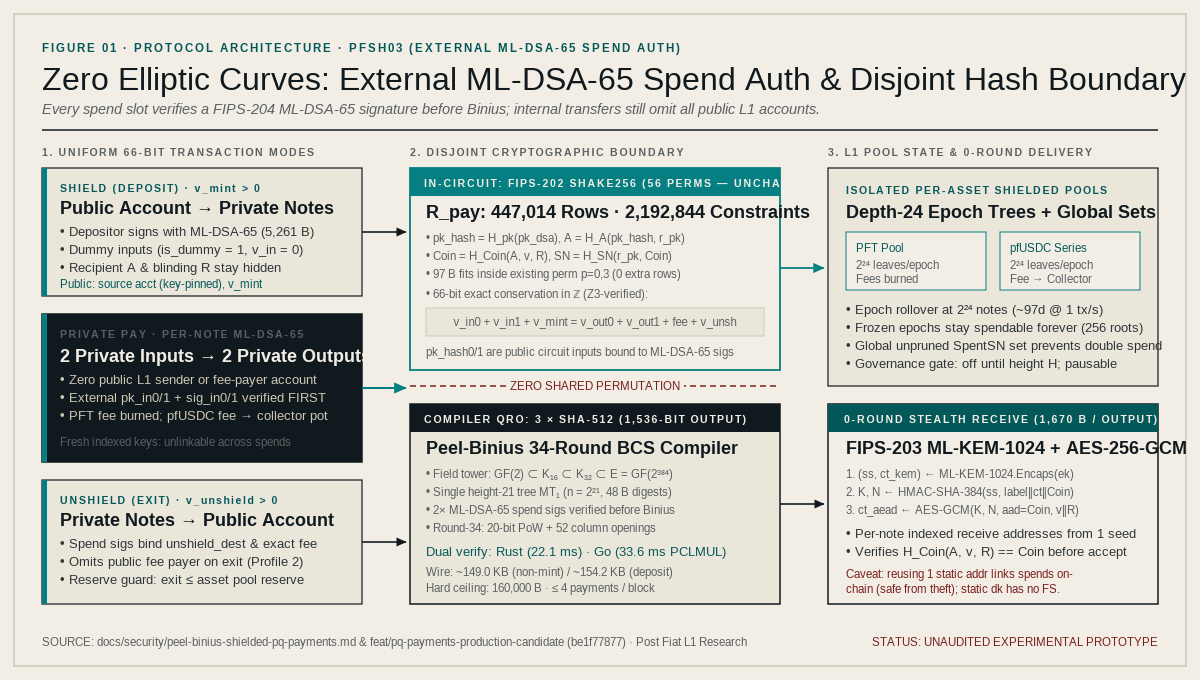 Figure 1. PFSH03 lifecycle across Deposit, Private Pay (external per-note ML-DSA-65 spend authorization + payerless issued-asset fee profile), and Exit, showing the disjoint SHAKE256 / 3×SHA-512 hash boundary, per-asset depth-24 trees, and non-interactive ML-KEM-1024 stealth delivery.
Every PFSH03 payment spends two private input slots (using zero-value dummy slots when needed) and creates two new private notes under one 66-bit unsigned integer conservation equation:
$$v_{\mathrm{in},0} + v_{\mathrm{in},1} + v_{\mathrm{mint}} = v_{\mathrm{out},0} + v_{\mathrm{out},1} + (\mathrm{fee} + v_{\mathrm{unshield}})$$Each value is a 64-bit unsigned integer, and consensus enforces \(\mathrm{fee} + v_{\mathrm{unshield}} < 2^{64}\), so neither side can overflow.
- Deposit (Shield): A public L1 account signs a post-quantum ML-DSA-65 deposit (
5,261 Bpublic key + signature), moving funds from its public balance into the asset’s private note tree. The recipient’s shielded address and blinding remain off-chain. - Private Transfer (no public L1 sender account): Each input slot carries an external per-note ML-DSA-65 public key and signature committing to the transaction context (outputs, envelopes, anchor, nullifiers, asset, epoch, fee, and exit destination), verified before Binius. Neither native PFT nor governed issued-asset (
pfUSDC) private transfers expose a public L1 sender or fee-payer account: PFT fees burn inside the proof, while issued-asset fees (0.000001 pfUSDCin rehearsal) collect in a governedcollected_private_feespot. - Offline Receive with Per-Note Indexed Addresses: Wallets derive fresh receive addresses (
wallet.address(index)) deterministically from one recovery seed—each with its own independent(pk_dsa, r_pk)blinded behindA = H_A(pk_hash, r_pk)—so senders need zero interactive round trips and never learnpk_dsa. Wallets scan outputs locally (~3,500–4,700trials/s/core in rehearsal) and accept a note only when decryption reproduces the public commitment. - Partial or Full Exit (Unshield): Spends private notes and credits a public L1 destination after checking per-asset pool reserves and destination trustline rules, without exposing a public sender account.
User, Governance & Operational Risks
- Two-tier exit-safe pause & block-capped (renewable) emergency exit-freeze:
- Tier 1 — Standard Pause (
pq_payment_rehearsal_v1, value = 0; standard BFT supermajority \(\lfloor 2n/3 \rfloor + 1 = 5/6\)): Halts new deposits (Shield) and private transfers (Internal) while keepingMode::Exitopen (preserving the last active issued-asset exit fee viapq_issued_fee_for_mode) so users can withdraw during a routine pause. - Tier 2 — Emergency Exit-Freeze (
pq_exit_freeze_until_v1): Freezing exits is isolated to a separate amendment requiring an elevated quorum (\(\min(n, \lfloor 5n/6 \rfloor + 1)\)—6 of 6 unanimous in rehearsal) and a mandatory block-height expiry hard-capped atMAX_PQ_EXIT_FREEZE_BLOCKS = 604,800blocks past inclusion height (~7 daysat1 sblocks, though wall-clock duration depends on actual block cadence). A single freeze amendment automatically expires atfreeze_until + 1with no governance action required, eliminating unattended indefinite freezes. However, because a unanimous validator set can enact consecutive renewals, users must still treat coordinated unanimous validator censorship as an explicit trust assumption rather than a hard cryptographic withdrawal guarantee.
- Tier 1 — Standard Pause (
- Static-address reuse links spends (safe against theft, weakens unlinkability): Because PFSH03 reveals
pk_inat spend time (never at receive time), fresh indexed receive addresses keep spends unlinkable across transactions. Reusing one static receive address across multiple notes does not weaken theft protection (ML-DSA-65 is many-time EUF-CMA), but spending two notes from that same static address publishes the samepk_dsaon-chain and publicly links those spends. Wallets must default to fresh per-note addresses and rotate change keys automatically. - Throughput ceiling, storage pruning & anonymity-set fragmentation: At
~150 KB/txand≤ 4proofs per block (640,000 Bblock cap), peak private throughput is~4.0–7.3 tx/s(~48–88 GiB/dayraw wire on full archive nodes). For non-archive validators,NodeStore::prune_pq_bodies(crates/storage/src/pq_archive.rs) deletes verifiedpq_bodies_v1proof blobs outside a kept checkpoint window—reclaiming~95%of PQ disk usage (~150 KB → ~4 KB/tx,~1.3–2.4 GiB/dayat ceiling) while retainingpq_pooloutput pages, commitments, envelopes, and global nullifiers for wallet scanning. Separate per-asset, per-epoch depth-24 trees (8,388,608two-output transactions per epoch,~13.4–24.3 daysat ceiling,~97.1 daysat1 tx/s) still fragment anonymity sets across assets and fresh epochs; unified multi-asset pools (MASP), depth-32 trees, and proof-size reductions are deferred to a future PFSH04 design. - Governance custody of issued-asset fees: Native PFT fees burn directly. For externally backed assets like
pfUSDC, routing inner fees intocollected_private_feespreserves exact supply conservation (public_balances + shielded_reserve + collected_private_fees == outstanding_supply), but disbursement relies on validator governance rather than an autonomous protocol rule. - Observable metadata & Orchard migration linkage: Observers still see asset IDs, exact fees, tree epochs and anchors, inclusion heights, nullifiers, commitments/envelopes, public deposit/exit accounts and amounts, and network IP/timing metadata. Moving funds from Orchard to PFSH03 requires a public exit followed by a public deposit, linking amounts and timing.
- Key hygiene & static-key compromise:
- Unpinned brand-new L1 deposit accounts: A brand-new public L1 account that has never signed a transaction is identified only by a 160-bit address hash (
~2^-32quantum preimage risk at2^64queries, vacuous at2^80). Once an account signs its first transaction,prepare_pq_account_debitpins its full1,952 BML-DSA-65 public key on-chain, eliminating 160-bit exposure; strict pre-debit enforcement is available viaprepare_pq_account_debit_pinned. Operational step: pin fresh accounts with one low-value signed self-transfer before large deposits; wallet-enforced pinning is part of Gate 3. - No incoming-note forward secrecy: Compromising a recipient’s long-term ML-KEM decapsulation key exposes past incoming envelopes encrypted to it (the same static-key tradeoff as Orchard).
- Unpinned brand-new L1 deposit accounts: A brand-new public L1 account that has never signed a transaction is identified only by a 160-bit address hash (
2. Proof Construction, Prover Optimizations & Wire Accounting
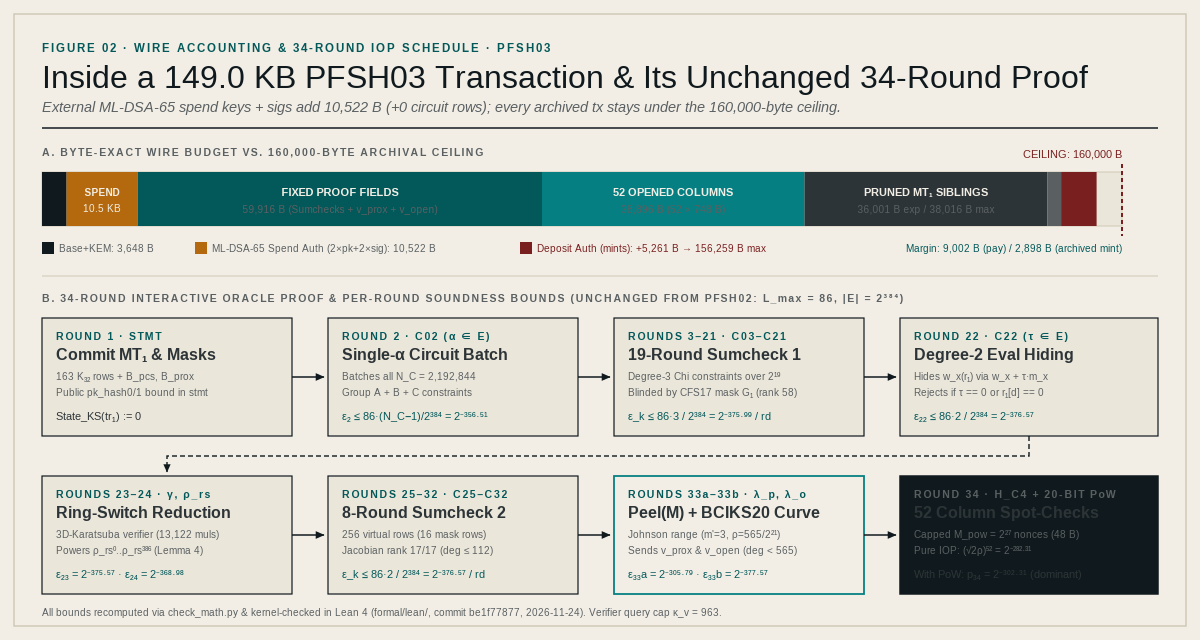 Figure 2. PFSH03 wire-size breakdown against the 160,000-byte archival cap (top), highlighting the 10,522-byte external ML-DSA-65 spend-authorization block, and the 34-round Peel-Binius interactive oracle proof schedule (bottom).
PFSH03 separates in-circuit state hashing from proof compilation across two disjoint NIST hash families with zero shared permutation:
- In-circuit (FIPS-202 SHAKE256): Every note owner address binds the hash of a per-note ML-DSA-65 public key to a secret blinding/nullifier key \(r_{\mathrm{pk}}\):
$$A = \mathrm{SHAKE256}\bigl(\texttt{0x00} \parallel \mathrm{pk\_hash}_{48} \parallel r_{\mathrm{pk},48}\bigr), \qquad \mathrm{SN} = \mathrm{SHAKE256}\bigl(\texttt{0x02} \parallel r_{\mathrm{pk},48} \parallel \mathrm{Coin}_{48}\bigr)$$
Because \(1 + 48 + 48 = 97 \le 135\) bytes fits inside one Keccak-\(f[1600]\) permutation (
p = 0, 3), all 56 permutations, Merkle muxes, dummy-input gating, and 66-bit conservation adders remain at447,014active rows (2,192,844constraints) over five bit-arrays whose only quadratic gates are Keccak’s \(\chi\) step. Publicpk_hash0andpk_hash1enter as constant statement bits. - Compiler Random Oracle (FIPS-180-4
3 × SHA-512): Proof Merkle nodes (MT_1, height 21), transcript absorbs, field challenges, and Round-34 queries come fromH(x) = SHA-512(0x00||x) || SHA-512(0x01||x) || SHA-512(0x02||x)with a512-bit internal Fiat–Shamir state and fixed-length prefix-free domain tags (encode_statement = 408 B).
Adapting the binary-tower polynomial commitment and ring-switching scheme of Diamond and Posen (Binius, ePrint 2023/1784) over \(\mathbb{F}_2 \subset K_{16} \subset K_{32} \subset \mathbb{F}_{2^{384}}\), five engineering optimizations drive verifier and prover performance:
- Exact 3D-Karatsuba ring-switch verifier: Cuts extension-field multiplications by
11×(derivation in the appendix). - Single-step binary-field kernels (
PCLMULQDQ, ARM64PMULL, portable & WASM32): 54-multiply Karatsuba routines with inlinemulC32reduction across Rust (PCLMULQDQ, branchless ARM64vmull_p64PMULL, portable, and sequentialwasm32-unknown-unknown +simd128) and Go (ASM +purego). - Fail-fast verifier ordering + cooperative 4-thread abort: Both Rust (
verify_abortable) and Go (verifyBiniusProof) verify external ML-DSA-65 spend signatures, Fiat–Shamir transcript replay, non-zero challenge guards, the 20-bit Round-34 PoW (eval_h_c4), opened-column count, and Ring-Switching sum check before circuit MLE evaluation, 3D-Karatsuba ring-switch, or Merkle path hashing. Parallel 4-proof block validation shares anAtomicBoolabort flag so sibling threads cancel on the first invalid proof. - Subtree-root streaming prover (
-37%peak RSS, bit-identical proofs): Instead of retaining201.3 MiBofMT_1leaf digests across Sumcheck 1, the prover retains only2,048height-10 subtree roots (192 KiB) and recomputes only the≤ 52touched 1,024-leaf subtrees at Round 34—cutting native peak RSS from572 MiBto355–361 MiBwhile producing bit-identical proofs. - WASM32+SIMD128 compilation: A
wasm32sequential parallel-iterator shim lets the exact Rust prover and verifier compile to an830 KB.wasmmodule measured directly in V8.
Wire Size & Archival Cap Accounting (160,000 B Cap)
External per-note ML-DSA-65 spend authorization adds 10,522 B (2 × 1,952 B pk + 2 × 3,309 B sig) to every transaction under the 160,000 B archival ceiling (640,000 B per 4-payment block). Measured proofs vary slightly because Merkle sibling-pruning collisions differ per transaction:
| Encoding Scope (Depth-24 Tree, 52 Column Openings) | Proof Basis | Measured / Expected | Margin vs. Cap | Worst-Case Ceiling | Ceiling Margin |
|---|---|---|---|---|---|
Standalone raw non-mint wire (14,170 B header+auth + proof) | Expected (134,813 B) | 148,983 B (148,814 B rollover) | 11,017 B | 150,998 B | 9,002 B |
L1 pfUSDC / PFT private pay (72 B prefix + 14,170 B + proof) | Measured (135,340 B) | 149,582 B | 10,418 B | 151,070 B (150,998 inner) | 8,930 B |
L1 pfUSDC private exit (72 B prefix + 14,170 B + proof) | Measured (134,668 B) | 148,910 B (148,958 PFT) | 11,090 B | 151,070 B (150,998 inner) | 8,930 B |
Standalone signed deposit wire (adds 5,261 B deposit ML-DSA-65) | Expected (134,813 B) | 154,244 B | 5,756 B | 156,259 B | 3,741 B |
L1 archived deposit — redb store (verified 153,143 B body + framing) | Measured (153,852 B stored) | 153,852 B (M8 max 155,902 B) | 4,098–6,148 B | 157,068 B | 2,932 B |
L1 archived deposit — JSONL store (adds JSONL envelope + digest) | Measured (153,886 B stored) | 153,886 B | 6,114 B | 157,102 B | 2,898 B |
Worst-case archived signed deposits leave 2,898–2,932 B of headroom under 160,000 B. We do not lower Round-34 column openings (t = 52) to save bytes: each dropped opening saves ~1.5 KB at a cost of ~5.4 bits of pure-IOP soundness and would require renewed soundness analysis and external re-audit.
3. Security Failure Modes, Lean 4 Scope & Audit Matrix
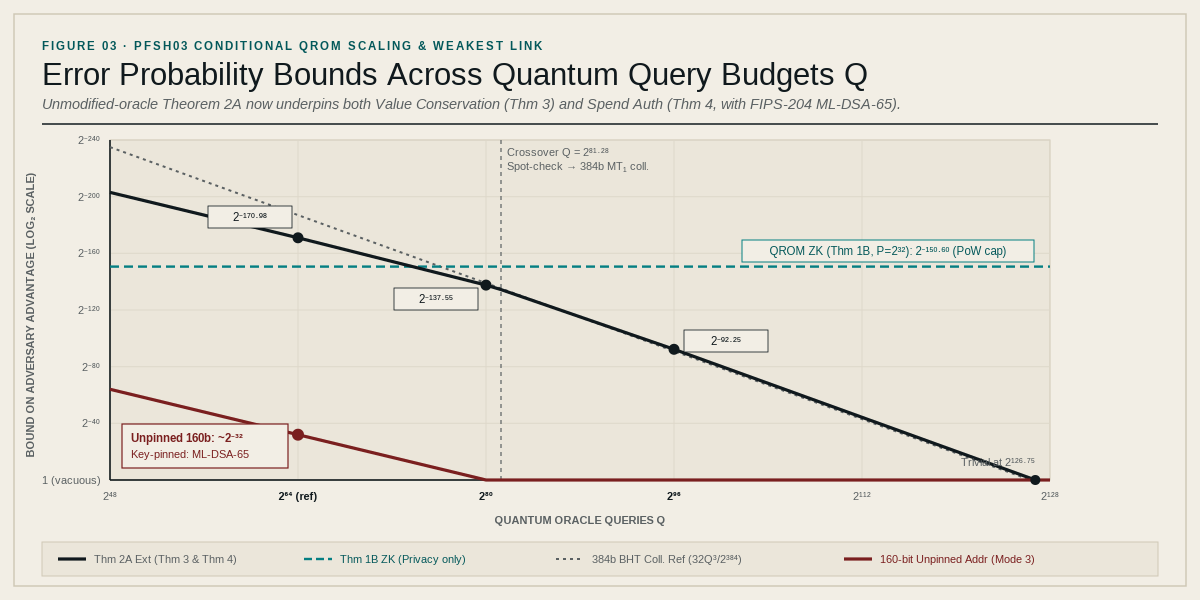 Figure 3. Conditional QROM advantage upper bounds versus quantum oracle query budget Q, showing unmodified-oracle Theorem 2A (shared by Value Conservation and Spend Authorization, becoming vacuous at Q = 2^126.75), the 384-bit tree-collision crossover at Q = 2^81.28, and the 160-bit unpinned deposit-account bound.
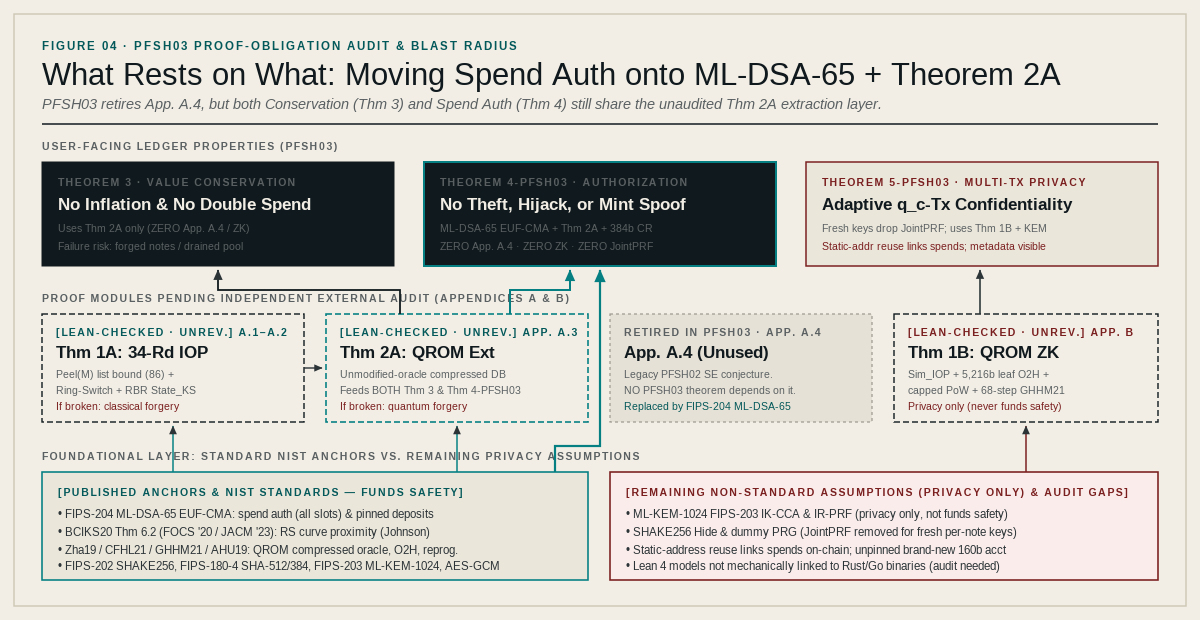 Figure 4. PFSH03 dependency and blast-radius map: PFSH03 retires Appendix A.4, moving Spend Authorization onto FIPS-204 ML-DSA-65 plus the still-unaudited Theorem 2A extraction layer shared with Value Conservation.
Throughout our security model, \(Q\) denotes an adversary’s total quantum queries to the random-oracle hash functions. Full theorem statements, symbol definitions, exact-rational QROM bounds, a Spec-to-Code & Lean 4 Traceability Matrix, and 18 prioritized external-reviewer questions live in the Companion Mathematical Appendix.
Honest assessment of Theorem 2A as a single point of failure—and what we hardened around it:
In PFSH03, moving spend signatures outside Binius retires our earlier unreviewed Appendix A.4 conjecture, QROM zero-knowledge, and SHAKE256 JointPRF/PRG from spend authorization. However, Theorem 3 (inflation resistance) and Theorem 4 (theft resistance) now share one unaudited QROM extraction proof (Theorem 2A / App. A.3) and the pk_hash0/1 circuit wiring: a flaw in either would compromise both. Ahead of external review, we tightened two concrete surfaces around Theorem 2A:
3 × SHA-512→ 1,536-bit QRO reduction (Lean 4): InCompressedOracle.lean(three_block_sha512_qro_reduction, axioms:[propext]only), we proved that because each 8-byte ASCII domain tag has a fixed input byte length (PFS-LEAF761 B,PFS-NODE110 B,PFS-STMT561 Bwith constant408 Bencode_statement,PFS-C4121 B)—making inputs prefix-free and ruling out Merkle–Damgård length extension—any \(Q\)-query adversary given independent quantum access to the 512-bit counter slices \(h(b \parallel x)\) (b ∈ {0, 1, 2}) is simulated with at most \(Q\) queries (zero query blowup) against the atomic 1,536-bit tuple oracle \(H(x) = (h(0\parallel x), h(1\parallel x), h(2\parallel x))\). Reviewers still must evaluate the SHA-512/SHA-384 shared-compression-function boundary (Reviewer Question #7).- Z3 + Rust/Go differential
pk_hash0/1circuit wiring verification: We expandedverify_circuit_equivalence.py(z3_pfsh03_56perm_pk_hash_wiring: unsat+rust_go_diff_verified) to check all 56 Keccak permutations, verify Rust/Goperm_input_specparity forpk_hash0/1andr_pk0/1inp = 0, 3, and run differential bit-flip tests onpk_in0andpk_in1confirming identicalpub_rhssensitivity in both Rust and Go.
Three failure modes define the external audit surface:
- Value conservation (Theorem 3 — inflation or double-spend risk): Concrete risks include misapplying BCIKS20, an error in our unaudited single-oracle QROM extractor (Theorem 2A / App. A.3), a spec-to-binary mismatch, or a circuit bug. Above \(Q = 2^{81.28}\), 384-bit proof-tree collisions overtake spot-check error and set the \(Q = 2^{126.75}\) vacuous-bound ceiling.
- Spend & deposit authorization (Theorem 4 — theft or transaction hijacking): Relies on FIPS-204 ML-DSA-65 EUF-CMA, unmodified-oracle Theorem 2A (unaudited, shared with Thm 3), 384-bit SHAKE256/SHA-384 collision resistance, and exact
pk_hash0/1wiring—plus the~80-bitunpinned deposit-account caveat (prepare_pq_account_debit_pinnedavailable for strict enforcement). - Multi-transaction confidentiality (Theorem 5 — privacy loss): Formalized as an adaptive \(q_c\)-transaction hybrid in Lean 4 (
pfsh03_theorem5_multitx_hybrid). With fresh per-note indexed addresses, cross-noteJointPRFdrops out; remaining privacy assumptions are QROM zero-knowledge (Theorem 1B / App. B), ML-KEM-1024IND-CCA2plus unreviewedIK-CCA/IR-PRF, HMAC-SHA-384, AES-256-GCM, and single-use SHAKE256Hideplus dummyPRG.
What Lean 4 Checks—and What It Does Not Check
We formalized the algebraic, operator-norm, wire-margin, and reduction plumbing across nine Lean 4 (v4.20.0) + Mathlib modules (formal/lean/PFSH02/, 2,847 LOC, zero sorrys, zero custom axioms—[propext, Classical.choice, Quot.sound] only). Boundary of machine checking: Lean checks parameter arithmetic, greedy peeling telescoping, rank-3 operator norm bounds, the 3-block SHA-512 → 1,536-bit QRO simulation, supply induction, and reduction accounting from explicit hypotheses. Proximity gaps (BCIKS20), the full compressed-oracle QROM extraction bridge, the GHHM21/AHU19 ZK bridges, real-world primitive assumptions, and Rust/Go binary equivalence enter as explicit hypotheses or lie outside Lean.
| Property & Failure Mode | Checked in Lean 4 (Model Plumbing & Bounds) | Outside Lean / Explicit Audit Hypotheses | Code Traceability & Automated Checks |
|---|---|---|---|
| Value Conservation & No Double Spend (Theorem 3 — inflation) | Exact-rational parameters, pfsh03_wire_margins_exact, greedy peeling (k ≤ 86), polynomial/ring-switch bounds, rank-3 operator norm (≤ √(8p)), three_block_sha512_qro_reduction, compressed-oracle telescoping, inductive supply conservation | BCIKS20 Thm 6.2; unaudited single-oracle extraction (App. A.1–A.3); SHAKE256 384-bit CR & zero-preimage; SHA-512/SHA-384 separation | Not mechanically linked to Rust/Go binaries; Z3 + 3-way Rust/Go/Python IR checks 66-bit adder, mux, dummy gating, and 56-perm Keccak DAG (verify_circuit_equivalence.py); manual external code audit required |
| Spend Authorization (Theorem 4, private spends — theft & tx hijacking) | pfsh03_spend_auth_dichotomy & pfsh03_theorem4_zero_appA4: accounting reduction to ML-DSA-65 EUF-CMA + unmodified-oracle Theorem 2A + 384-bit CR (retires App. A.4, ZK & JointPRF) | FIPS-204 ML-DSA-65 EUF-CMA + unaudited App. A.1–A.3 (shared SPOF with Thm 3) + 384-bit SHAKE256/SHA-384 CR + full pk_hash0/1 wiring audit | Z3 + differential Rust/Go pk_in0/1 bit-flip check (unsat+rust_go_diff_verified) + 39 adversarial controls (incl. 4 ML-DSA-65 spend-auth attacks); not mechanically linked to binaries |
| Deposit Authorization (Theorem 4, public deposits — deposit forgery) | mode3_key_pinned_eliminates_160bit: pinning the full ML-DSA-65 pubkey removes the 160-bit preimage term | ML-DSA-65 EUF-CMA + SHA-384 CR for pinned accounts; unpinned brand-new accounts remain weak (160-bit preimage) | prepare_pq_account_debit + strict prepare_pq_account_debit_pinned in crates/execution/src/entrypoints.rs; manual audit required |
| Multi-Tx Confidentiality (Theorem 5 — privacy loss) | pfsh03_theorem5_multitx_hybrid: adaptive q_c-tx hybrid accounting + unopened-leaf ZK bijection (5,216 bits), capped-PoW TV (< 2^-182), GMP22 implicit-rejection sub-hop | Unaudited App. B (GHHM21/AHU19 bridges); ML-KEM-1024 IND-CCA2/IK-CCA/IR-PRF, HMAC, AES-GCM, single-use Hide & dummy PRG; fresh per-note addresses required | Not mechanically linked to wallet/KEM code |
4. Benchmarks, Fail-Fast Rejection, Rehearsals & Test Results
All native PFSH03, WASM32, and Orchard measurements ran on 24 November 2026 on one shared 32-vCPU AMD EPYC KVM host (PCLMULQDQ, AVX2, SHA-NI). Standalone PFSH03 and Orchard verification tests ran n = 50 trials per condition pinned to CPU 2 (RAYON_NUM_THREADS=1, GOMAXPROCS=1). Inside-validator PFSH03 runs used n = 21 trials per condition across PFT and pfUSDC, warm and cold (128 MiB L3 eviction), against 1,024 history entries (RAYON_NUM_THREADS=4 on CPU 0–3 for parallel 4-proof blocks). The wasm32-unknown-unknown +simd128 run executed the compiled 849,531 B (830 KB) .wasm module in Node.js v20.20.2 (V8, 1 thread, pinned CPU 2). These are single-host measurements, not universal hardware guarantees.
4.1 Full Verification, Fail-Fast Rejection & Proving Matrix (Internal Targets: < 50 ms 1-Tx Max, < 200 ms 4-Tx Parallel Block Max)
| Workload | Backend & Concurrency | Per-Condition Medians | p95 | Largest Observed Max | Target Status |
|---|---|---|---|---|---|
Orchard 1-tx baseline (n = 50, cached VK) | Halo 2 + RedPallas, 1 core CPU 2 | 44.26 ms | 47.01 ms | 47.82 ms | Baseline |
Orchard 4-tx batch baseline (n = 50, cached VK) | Standalone BatchValidator, 1c / 4c | 87.36 / 34.54 ms | 90.48 / 34.65 ms | 93.96 / 34.75 ms | Baseline |
PFSH03 standalone Rust (mint/hop1/hop2, n = 50) | Accelerated (PCLMULQDQ), 1 core | 22.09–22.21 ms | 22.27–22.55 ms | 25.12 ms | Met (< 50 ms) |
PFSH03 standalone Go (mint/hop1/hop2, n = 50) | Accelerated (PCLMULQDQ ASM), 1 core | 33.62–33.66 ms | 33.97–34.02 ms | 35.28 ms | Met (< 50 ms) |
PFSH03 standalone Go portable (mint/hop1/hop2, n = 50) | -tags purego (0 ASM), 1 core | 45.42–46.02 ms | 46.44–46.82 ms | 48.47 ms | Met (< 50 ms) |
PFSH03 fail-fast invalid reject (n = 20, 1 core) | Bad ML-DSA-65 sig / Bad 20-bit PoW / Valid-PoW bad Merkle | 0.22 ms / 0.53 ms / 15.33 ms | — | Sibling abort 0.0002 ms | Microbenchmarked (Gate 1 DoS audit open) |
PFSH03 validator 1-tx (PFT & pfUSDC, warm/cold, n = 21) | Accelerated, 1 core pinned | 24.54–25.13 ms | 24.77–37.92 ms | 38.01 ms | Met (< 50 ms) |
PFSH03 validator 1-tx (PFT & pfUSDC, warm/cold, n = 21) | Portable (no PCLMULQDQ), 1 core | 36.90–37.83 ms | 37.67–45.46 ms | 45.52 ms | Met (< 50 ms) |
PFSH03 validator 4-tx (PFT & pfUSDC, warm/cold, n = 21) | Accelerated, 4-core parallel | 47.35–47.78 ms | 47.56–65.93 ms | 88.36 ms | Met (< 200 ms) |
PFSH03 validator 4-tx (PFT & pfUSDC, warm/cold, n = 21) | Portable, 4-core parallel | 79.22–79.69 ms | 79.41–80.07 ms | 107.76 ms | Met (< 200 ms) |
PFSH03 validator 4-tx (PFT & pfUSDC, warm/cold, n = 21) | Accelerated, 1 core sequential (pre-fail-fast) | 95.47–140.89 ms | 96.31–190.15 ms | 135.38 ms valid · 209.43 ms invalid | Missed on 1c invalid burst (4c required + fail-fast added) |
PFSH03 validator 4-tx (PFT & pfUSDC, warm/cold, n = 21) | Portable, 1 core sequential | 146.57–147.90 ms | 147.88–184.70 ms | 185.36 ms valid · 195.28 ms invalid | Tight on 1c (4c required in Gate 2) |
Orchard proving-only (n = 50, cached PK) | 16 thr / 1 core CPU 2 | 1.29 s / 5.13 s | 1.36 s / 5.66 s | 1.42 s / 6.33 s | Baseline |
PFSH03 proving-only (subtree-streaming) (355–361 MiB RSS) | 16 thr (n = 3) / 1 core (CPU 2) | 2.66 s / 25.67 s | 2.69 s / — | 2.69 s / 25.67 s | -37% RSS vs. 572 MiB baseline (24.62 s 1c n = 10) |
PFSH03 WASM32+SIMD128 (830 KB .wasm, 378.9 MiB linear mem) | Node.js v20.20.2 V8, 1 thread CPU 2 | 39.36 s prove / 70.80 ms verify | — | 232.72 ms verify max | First browser-engine measurement (iOS/Android untested) |
Before our fail-fast verifier reordering, a single-core cold invalid 4-proof burst hit 209.43 ms. Checking external ML-DSA-65 signatures (0.22 ms), transcript replay, and the 20-bit Round-34 PoW (0.53 ms) before circuit MLE, 3D-Karatsuba, or Merkle paths—paired with 4-thread cooperative AtomicBool sibling cancellation (0.0002 ms)—raises the per-proof attacker cost to reach the 15.33 ms Merkle stage to ~2^20 SHA-512 PoW evaluations. Because microbenchmarks alone do not establish network-level DoS resilience (P2P bandwidth saturation, mempool queues, and coordinated invalid-batch bursts), adversarial invalid-proof flooding and mempool admission backpressure are explicitly included in Gate 1’s external audit scope alongside Gate 2’s ≥ 4-core hardware qualification.
4.2 Consolidated Test, Replay, Rehearsal & Formal Suites (PFSH03)
| Suite | Result (24 Nov 2026) |
|---|---|
Lean 4 formal proof library (formal/lean/) | 9 / 9 modules built (2,847 LOC), 0 sorrys, 0 custom axioms (lake build PFSH02, Lean v4.20.0 + Mathlib; includes three_block_sha512_qro_reduction) |
Full postfiat-node --lib suite | 751 passed, 0 failed (incl. two_tier_pq_pause_keeps_exits_open_and_emergency_freeze_auto_expires; 45 pre-existing #[ignore] opt-in external-bridge/legacy tests; 0 PQ tests ignored) |
Six-validator activation rehearsal (M8) | Passed in 32.06 s (worst_uncached_verify_l1_ms = 24.38 ms, largest body 155,159 B, 4-proof block 621,112 B ≤ 640,000 B, exit-safe pause at height 29, cold restart & signed snapshot import) |
7-stage standalone driver (verify.sh) | 7/7 passed (Rust + Go PCLMUL + Go purego + 39 named attacks incl. 4 ML-DSA-65 spend-auth attacks + 150 fuzz mutations + full \(2^{24}\)-leaf rollover + Go delivery-helper cross-check + check_math.py + expanded Z3 5.4.1 pk_hash0/1 differential audit) |
| Library & wallet crates | postfiat-privacy-binius (10/10 accel, 10/10 portable incl. fail-fast DoS test), postfiat-privacy-binius-wallet (8/8 + Go cmd/delivery), postfiat-storage PQ archive (2/2 incl. prune_pq_bodies), Python CLI (9/9, 8 finalized payments across epoch rollover, 92 RPC secret-leakage checks) |
Historical live-devnet replays (R64 + 1,754-block) | 1,734-block R64 pre-activation archive replay (c28eb872...5910, exact 1B PFT supply) + 1,754-block devnet replay (246d6113...4b8e6) |
| Un-upgraded validator upgrade check | Pre-activation validator build halts fail-closed on the scheduling amendment (unsupported governance amendment kind) rather than forking |
Note: Rust, Go, Python, Z3, and Lean artifacts share one author team, so cross-language agreement checks internal consistency rather than independent external review.
5. Build Provenance, Evidence Artifacts & Activation Gates
Build provenance: postfiatorg/postfiatl1v2, branch feat/pq-payments-production-candidate, commit be1f778779450db1bf3a61f281da14d423a295c3 (be1f77877, cleanly mergeable onto public/main).
| Artifact | Scope | Direct Link |
|---|---|---|
| Companion Mathematical Proofs, Traceability Matrix & Reviewer Questions | PFSH03 symbol glossary, 9-module Lean 4 map (2,847 LOC), 3 × SHA-512 QRO reduction, Theorem 4 & 5, Spec-to-Code Traceability Matrix & 18 reviewer questions | /research/pfsh03-proofs/ |
| Lean 4 Proof Suite (Source) | 9 modules (2,847 LOC), lakefile.toml, README.md | formal/lean/ |
| Consolidated Evidence Packet (JSON) | PFSH03 provenance, Lean 4 summary, Orchard, native/WASM32, fail-fast rejection & validator tables | pq-private-payments-evidence-packet-20261124.json |
| External Cryptographic Review Package | Source inventory, payment trace & reviewer scopes | external-review-package.md |
| Rehearsal & Archive Replay Record | Six-validator M8 activation/pause/restart log plus separate R64 1,734-block pre-activation archive replay | rehearsal-record.md |
| Exact-Rational Math, Z3 & SHA-256 Manifest | math_bounds.json, circuit_equivalence.json (z3_pfsh03_56perm_pk_hash_wiring) & 36-file SHA256SUMS | math_bounds.json · circuit_equivalence.json · SHA256SUMS-consolidated.txt |
Reproduce Locally
Tested toolchain & resources: Lean v4.20.0 (elan + lake exe cache get), Rust 1.85+ (cargo --locked), Go 1.25.1, Python 3.12 + z3-solver 5.4.1 (or tools/pft-binius-shielded-pq/Dockerfile). Expect ~2 min for Lean 4, ~3 min (~3.7 GiB RSS) for verify.sh, ~5 min for the n = 50 1-core Orchard run, ~6 min for postfiat-node --lib, and ~1 min for the six-validator rehearsal.
git clone https://github.com/postfiatorg/postfiatl1v2.git
cd postfiatl1v2
git checkout be1f778779450db1bf3a61f281da14d423a295c3   # branch feat/pq-payments-production-candidate (PFSH03)

# 1. Build and kernel-verify all 9 Lean 4 proof modules (2,847 LOC, 0 sorrys, 0 custom axioms)
(cd formal/lean && lake exe cache get && lake build PFSH02)

# 2. Verify 36 fixture/script checksums & run the 7-stage standalone suite (incl. Z3 pk_hash0/1 audit)
(cd tools/pft-binius-shielded-pq && sha256sum -c SHA256SUMS && ./verify.sh)

# 3. Run fail-fast DoS & pruned-storage crate tests (accel & portable)
cargo test --release --locked -p postfiat-privacy-binius -- --nocapture
cargo test --release --locked -p postfiat-privacy-binius --features portable
cargo test --release --locked -p postfiat-storage --lib pq_archive

# 4. Run the postfiat-node library suite (751 tests, incl. two-tier pause & 7-day exit freeze) and 6-validator M8 rehearsal
cargo test --release --locked -p postfiat-node --lib
cargo test --release --locked -p postfiat-node --bin postfiat-node -- pq_payment_rehearsal_tests --nocapture --test-threads=1
Three Gates Before Mainnet Activation
No activation date is set; PFSH03 stays disabled on mainnet until all three gates close and the final release commit reproduces every artifact:
- Independent cryptographic, DoS & implementation audit: External cryptographers and systems auditors must publish a signed audit covering Theorem 3 (value conservation), Theorem 4 (external per-note ML-DSA-65 spend authorization + unmodified-oracle Theorem 2A +
3 × SHA-512/SHA-384 boundary +pk_hash0/1circuit wiring), Theorem 5 (multi-transaction adaptive confidentiality and remaining privacy assumptionsIK-CCA,IR-PRF,Hide, dummyPRG), adversarial invalid-proof DoS flooding and mempool admission backpressure, Lean 4 model-to-code correspondence, and the Rust/Go/L1 settlement and two-tier governance code—with every high or critical finding resolved and re-verified on the release commit. - Production-genesis cut, measured hardware qualification, and scale/mobile validation:
- Replace the disposable rehearsal genesis/series lock (
pq_rehearsal_domain) with mainnet genesis and the livepfUSDCseries; - run reproducible qualification benchmarks on representative validator hardware (x86-64 and ARM64) verifying
< 200 msmax latency on attacker-crafted 4-proof invalid batches with≥ 4verification cores; - implement and verify bounded-time node restart and index checkpointing at multi-million-note (
2^24-leaf) scale (cold restart currently walks historical pair pages); and - extend our
39.36 sV8 WASM32 baseline with real iOS/Android mobile WebView, ARM64PMULLdevice, and multi-threadedSharedArrayBufferWASM proving benchmarks.
- Replace the disposable rehearsal genesis/series lock (
- Validator upgrade, governance vote, and Orchard migration plan: After all validators install the audited release binary pinned to the final release commit, ratify a BFT-supermajority governance amendment choosing live activation height \(H\), paired with wallet-enforced automatic key pinning (
prepare_pq_account_debit_pinned) for brand-new L1 deposit accounts, fresh per-note receive-address defaults, Orchard exit/re-deposit tooling, and explicit user-facing privacy guidance on migration linkage.
Open-source repository: postfiatorg/postfiatl1v2 (branch feat/pq-payments-production-candidate, commit be1f77877). External reviewers can begin with formal/lean/, the Companion Mathematical Appendix & Traceability Matrix, and the External Review Package.